30/07/26 Thu 10:35am
Intro to System Engineering
Importance → system requirements define measurable targets for design and validation
example EV power train requirements
- 0 -100 km/h acceleration 10 seconds
- battery range 400 km per charge
Requirements help in:
bench-marking performance
ensuring component compatibility
trade-offs in system engineering
Efficiency vs cost
performance vs weight
safety vs manufacturability
A well designed set of system requirement ensures an optimal balance.
Understanding an EV as a System
An EV consists of multiple interconnected components, including:
- battery pack
- motor & motor controller
- Power Electronics
- thermal management system
- braking system
- chassis & sensors
- communication networks
System Boundary of an EV
- The vehicle itself forms the system boundary
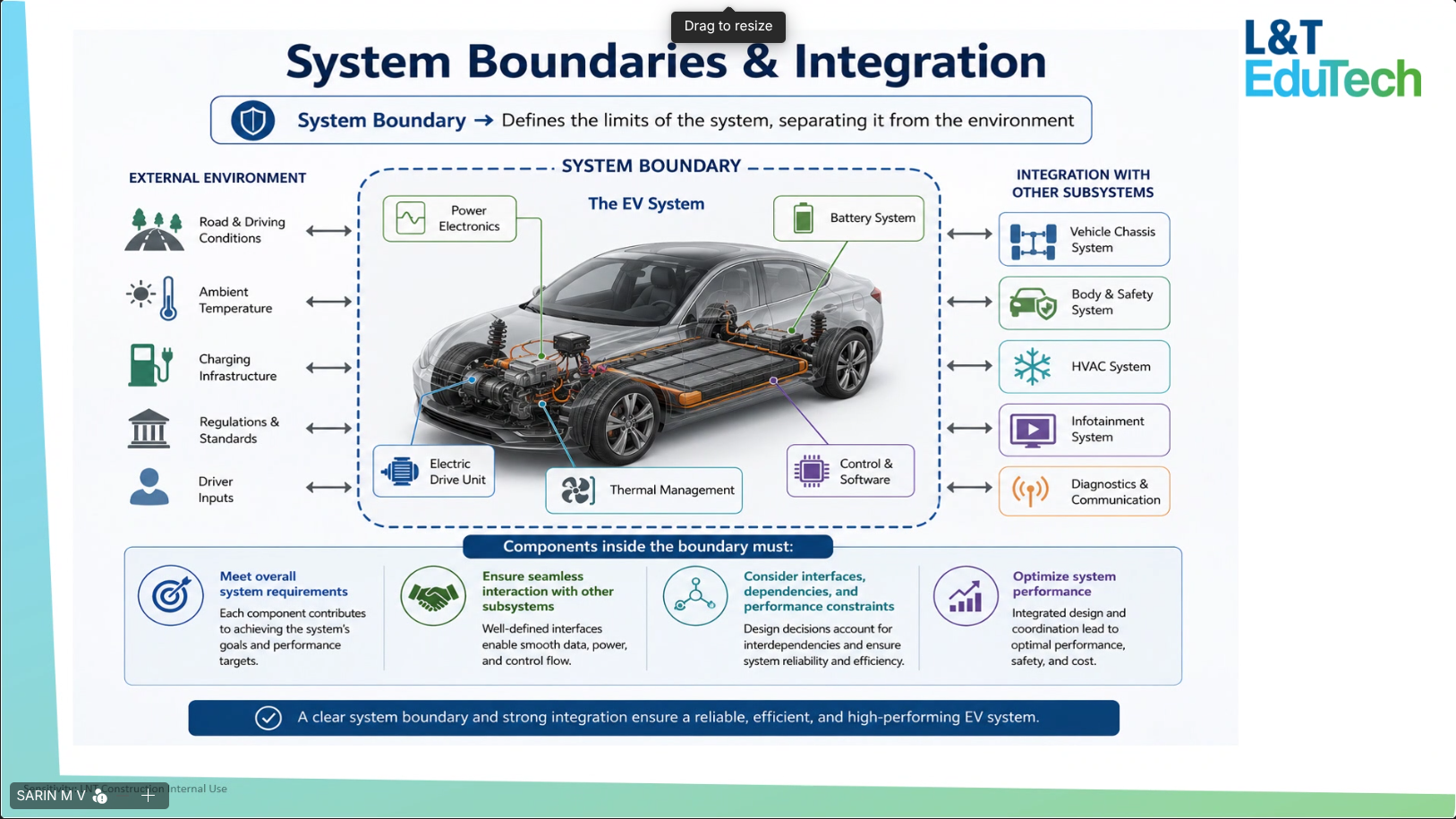
The System Perspective: Beyond Individual Components
- Analyzing individual components alone is not enough to predict full vehicle behaviour
- Subsystem interactions can cause emergent behaviours — Unexpected effect not seen in isolation.
- A holistic approach ensures seamless integration and optimal operation
Illustrative Examples:
Larger Battery
- Increases driving range
- Adds weight → impacts acceleration, braking, and structural intergrity
Regenerative Braking - Improves energy efficiency
- Must be balanced with mechanical braking for safety & stability across conditions
- Systems thinking ensures EV design is not just optimal at component level, but coherent, safe, and efficient as a whole.
System Success Vs. System Failure
- Success:
- Desired behaviour emerges as expected
- Failure occurs when:
- Expected behavior doesn’t occur
- E.x, EV expected to run 300 km only acheives 250 km due to unforseen power losses
- Unexpected, undesirable behaviour occurs
- E.g, Thermal-electrical interaction causing battery overheating
- Expected behavior doesn’t occur
Introduction to System Engineering Process
- After grasping the definition and approach of systems engineering, the next step is to understand its step is to understand its structured process
- This methodology ensures a Logical, efficient development cycle for complex systems like EV powertrains
- Why it matters:
Guides engineers through requirement definition, design, integration, and validation - Ensures each phase is aligned with system objectives, performance, and reliability needs
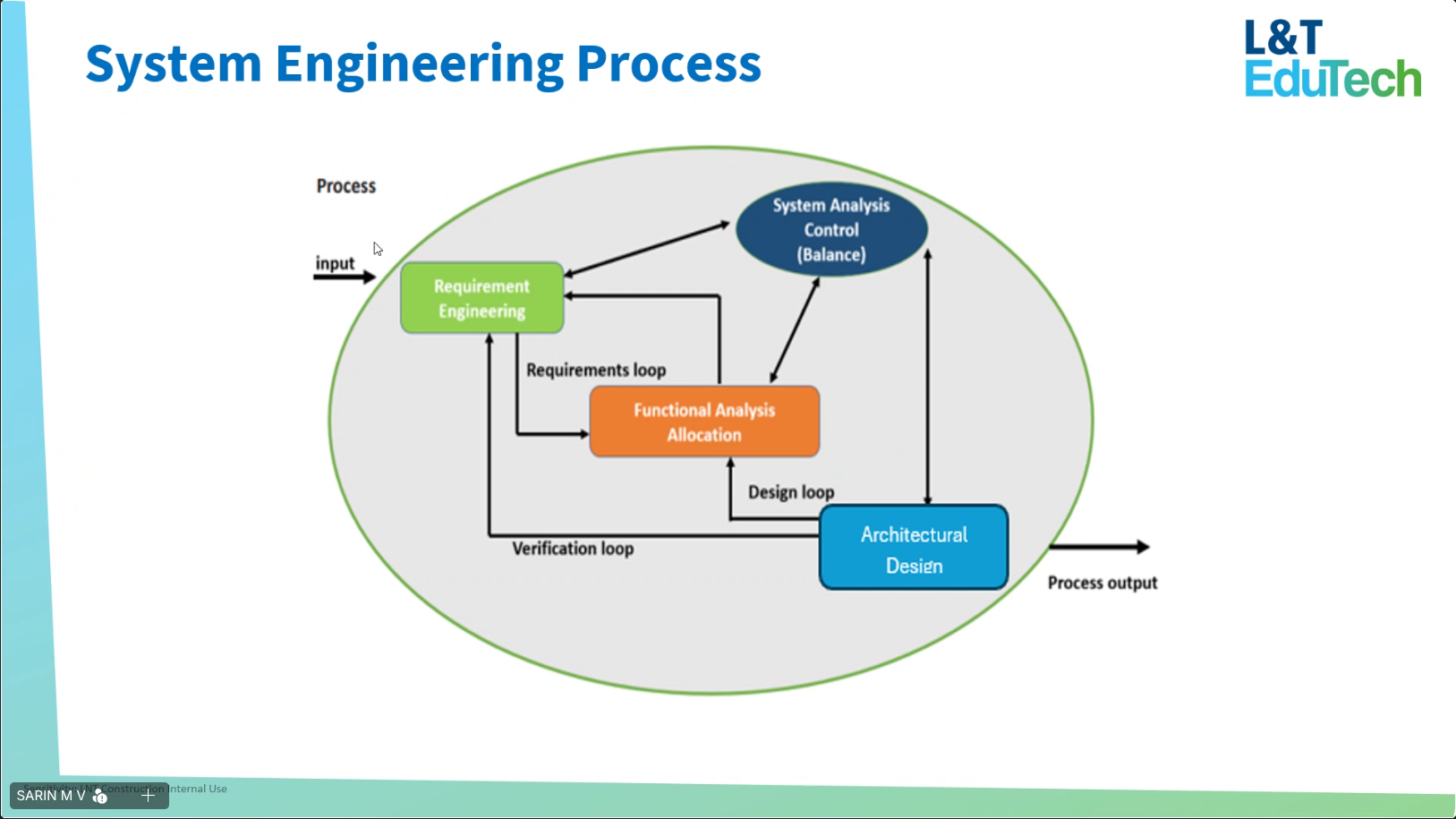
Systems Engineering Process
- Requirements Engineering
- Define and document clear, measurable system requirements.
- Functional Analysis & Allocation
- Break down system-level requirements into subsystems and components.
- Ensure functional alignment across different domains.
- Synthesis (System architecture development)
- Design and integrate hardware & software architectures.
- Ensure seamless operation of all components.
- Verification & Validation (V&V)
- Test & validate that the system meets design specifications.
- Ensure efficiency, safety, and reliability through systematic testing.
Requirement Specifications for an EV Powertrain
Why Quantitative Specifications Matter?
→ Clear requirement engineering ensures performance, efficiency, and competitiveness in EV design.
→ Quantitative targets help in component selection and system optimization.
Example: Acceleration Requirement
- Specification: The EV must accelerate from 0 to 100 km/h within 8 seconds.
- Which ensures quick response for better drivability & market competitiveness.
- Requires sufficient torque & efficient power delivery from the motor & battery.
Example: Driving Range Requirement
- Specification: The EV should have a minimum range of 400 km per charge under standard test conditions.
Example: Gradeability Requirement
- Specification: The EV must maintain 40 km/h speed while climbing a 15% gradient with a full load.
System Requirement and System Function
Understanding the difference
System Requirements ( What the System Must Achieve )
- Define high-level, measurable objectives based on user needs, market demands, or regulations.
- Examples:
- EV must have a top speed of 150 km/h.
- EV should have a range of 400 km per full charge