What is Overall Vehicle Performance?
It refers to the comprehensive evaluation of how a vehicle operates and fulfils its intended purposes, including its efficiency, reliability, safety, comfort, and responsiveness.
Key Components of Overall Vehicle Performance
-
Performance Parameters:
- Acceleration: How quickly the vehicle can increase its speed influenced by the engine or motor power, torque, and weight.
- Top Speed: The maximum speed a vehicle can achieve under ideal conditions.
-
Fuel Efficiency(Energy Efficiency):
- Measures how effectively the vehicle uses fuel or energy ( for electric vehicles ) to travel a certain distance. (mileage for ICE)
- Parameters like miles per gallon (MPG) for ICE or per kilowatt-hour (kWh) for EVs
-
Ride Comfort:
- Determined by the suspension system, seating design, noise insulation, and vibration damping.
- Affects passenger satisfaction, particularly on long drives or uneven roads.
-
Safety:
- Includes both active safety systems like the Anti-lock Braking System (ABS), Electronic Stability Control (ESC), and passive safety systems like airbags, crumple zones, etc.
- Evaluates the vehicle’s ability to protect occupants and pedestrians in normal conditions and during accidents.
-
Durability and Reliability:
- The ability of the vehicle and its components to withstand wear and tear.
- Affects maintenance costs and the vehicle’s lifespan.
-
Environmental Impact:
- Refers to emissions for ICE and energy efficiency for electric vehicles.
- Includes adherence to environmental standards like EURO or BS norms.
-
Load and Towing Capacity:
- The maximum weight the vehicle can carry or tow without compromising performance or safety
- relevent for commercial vehicles and utility vehicles like SUVs and trucks.
-
Aerodynamic Performance:
How well the vehicle minimizes drag (air resistance), impacting fuel efficiency, speed, and stability. -
Traction and Drivability:
The vehicle’s ability to maintain grip on different road surfaces, especially under adverse conditions like rain, snow, or loose gravel. -
Technological Features:
- Includes modern advancements like adaptive cruise control, automated driving aids, and infotainment systems.
- Enhances both convenience and functionality.
Factors Affecting Overall Vehicle Performance
- Mechanical Systems:
- Engine/motor design, transmission efficiency, suspension setup, and brake systems are key contributors.
- Aerodynamics:
- The design of the body influences drag, stability, and fuel efficiency.
- Weight Distribution:
- proper weight distribution ensures better handling, stability, and braking performance.
- Driver Inputs:
- The skill and behaviour of the driver play a significant role in how the vehicle performs in real-world conditions.
- External Conditions:
- Weather, road quality, and traffic significantly influence perceived performance.
Key Angles in Vehicle Dynamics:
1. Yaw Angle ( ):
Represents the rotation of the vehicle around its vertical (z-axis).
it defines the vehicle’s orientation in the horizontal plane, such as when it turns left/right.
critical in steering, cornering, and stability analysis.
2. Pitch Angle ( ):
The rotation of the vehicle about its lateral (y-axis).
describes the front-back tilt of the vehicle, such as during acceleration ( nose lifts ) or braking (nose dives).
3. Roll Angle ( ):
rotation about the longitudinal (x-axis).
describes the side-to-side tilt of the vehicle, such as when cornering, or traversing uneven terrain.
4. Slip Angle ( ):
the angle between the direction a tire is pointing to and the actual direction it is moving.
key in understanding tire behavior, traction, and handling characteristics.
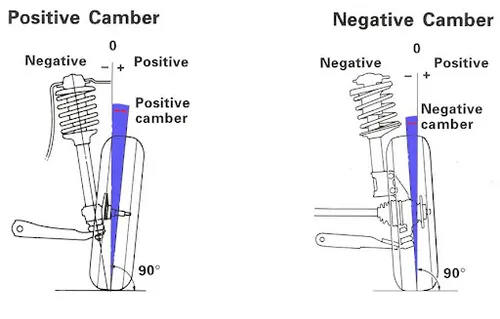
5. Camber Angle:
The tilt of the wheel relative to the vertical axis when viewed from the front or rear.
Positive camber: top of the wheel tilts outward
Negative camber: top of the wheel tilts inward
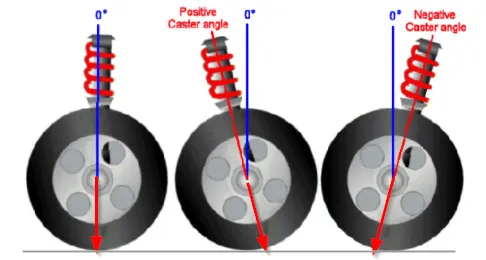
6. Caster Angle:
The angle between the steering axis and the vertical axis when viewed from the side.
Positive caster improves stability and steering feel at high speeds.
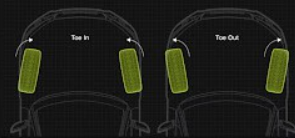
7. Toe Angle:
The angle between the tire’s orientation and the vehicle’s longitudinal axis viewed from above.
8. Steering Angle:
The angle at which the front wheels are turned relative to the vehicle’s longitudinal axis. Directly influences turning radius and cornering dynamics.
Key Coordinate Systems in Vehicle Dynamics:
to analyze a vehicle’s motion, the following coordinate systems are used:
- Global Coordinate System (Inertial Frame)
- Vehicle Coordinate System (Body Frame)
- Tire Coordinate System
- Road or Track Coordinate System
- Suspension Coordinate System
1. Global Coordinate system ( inertial frame )
A fixed reference frame relative to the earth used to define the vehicles overall position and motion.
Axes:
- X-axis: points forward in the direction of travel.
- Y-axis: sideways perpendicular to X-axis.
- Z-axis: Points vertically upward.
useful for analyzing external forces like gravity, wind resistance, etc.
2. Vehicle Coordinate System ( body frame )
a moving frame anchored to the vehicle.
Axes:
- X-axis:(longitudinal) Runs along the length of the vehicle pointing forward.
- Y-axis:(lateral) Runs across the vehicle, pointing either left or right.
- Z-axis:(Vertical) Runs perpendicular to the ground, pointing upward.
Used for analyzing forces, moments, and velocities specific to the vehicle.
3. Tire Coordinate System
used to analyze forces and moments acting on individual tires
Axes:
- X-axis: direction of wheel rotation and vehicle motion
- Y-axis: Perpendicular to the tire’s rolling direction.
- Z-axis: Normal to the ground, pointing upward.
4. Road or Track Coordinate system:
A reference frame alinged with the road surface.
useful for analyzing contact forces, road banking, and surface interactions.
Axes are aligned with the road’s longitudinal, lateral, and normal directions.
5. Suspension Coordinate System:
A local reference frame for analyzing suspension components.
Defines motions like wheel travel, caster, camber, and toe angles.
Degrees of Freedom in Analyzing Vehicle Dynamics
In vehicle dynamics, degrees of freedom (DOF) refers to the number of independent motions that can be calculated in a vehicle model (or) Degrees of Freedom represent the independent motions a system can exhibit.
- 6 DoF for body, 6 DoF for a suspension system
- 2 DoF for steering system
- A complete vehicle model requires 16 DoF
- 16 higher-order simultaneous governing differential equations must be solved to simulate the behaviour.
Lateral Dynamics
- low speed turning and steering geometry
- Understeer and Oversteer
- Roll behaviour
- Wheel slip and tyre characteristics are the vital parameters for vehicle handling
Lateral dynamics arise due to cornering of the vehicle. It is necessary to compute the magnitude of these disturbing forces in order to design safety systems like the yaw stability control and active roll control. Computing the roll characteristics serves as an input for the design of suspension components such as anti-roll bar etc.
Vertical Dynamics
- Characterized by suspension system parameters such as spring stiffness, damping coefficient, ride rate etc
- Superior ride quality is achieved when the you incorporate semi-active / active suspension to the systems. However the entire vehicle’s performance and safety is governed by the tyre-road friction characteristics irrespective of the sophistication of the systems.
The vertical dynamics performance of the vehicle is very relevant especially for Indian road conditions where plenty of bumps, potholes and unevenness are encountered. Many international sellers tune their suspension system to meet and perform well in the Indian road conditions.
this assumes more importance in case of EVs since their inherent weight itself is high. The primary and critical requirement of vertical dynamics is to ensure continuous tyre road grip.