Henry Mintzberg’s model of managerial roles.
In his model, managers play 10 different roles, all organized into sets of behaviours allotted a position, that can be split into three basic categories.
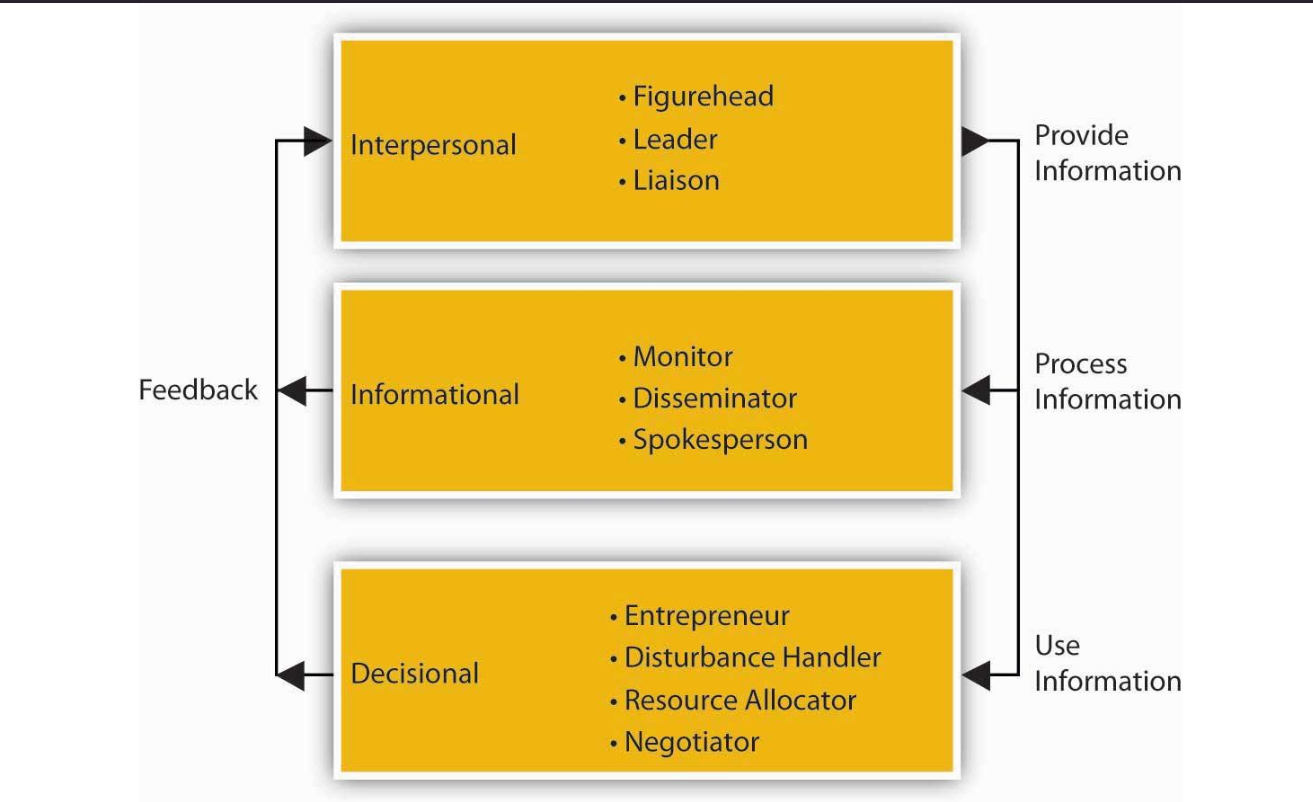
Interpersonal roles
1. Figurehead role
By virtue of their position as head of an organizational unit, every manager must perform some duties of ceremonial nature.
ex:
a. The president greeting the touring dignitaries and attending ribbon cutting ceremonies.
b. the foreman attends the wedding of a lathe operator,
c. the sales manager takes an important customer to lunch.
Duties that involve interpersonal roles may sometimes be routine, involving little serious communication and no important decision-making
nevertheless they are important to the smooth functioning of an organization
and cannot be ignored by the manager.
2. Leader Role
since they are in charge of an organizational unit, the manager is responsible for the work of the people of that unit. Their actions in this regard constitute the leader role.
they might involve leadership directly like:
- in most organizations the manager is normally responsible for hiring and training their staff.
- every manager must motivate and encourage their employees, somehow reconciling their individual needs with the goals of the organization.
Formal Authority vests them with great potential power; leadership determines in large part how much of it they will realise.
3. Liaison Role
In this role the manager makes contacts outside their vertical chain of command. Managers spend as much time with peers and other people outside their units as they do with their own subordinates, and surprisingly little time with their own superiors.
The manager cultivates such contacts largely to find information.
this role is devoted to building up the manager’s own external information system - informal, private, verbal, but nevertheless effective.
Informational roles
4. Monitor role
as a monitor the manager must continuously scan their environment for information , get contacts from liaison and subordinate contacts or a network of personal contacts.
a large part of the information the manager collects in this role arrives in the verbal form, often as gossip, hearsay, and speculation.
by virtue of their contacts the manager has a natural advantage in collecting this soft information for their organization.
5. Disseminator role
the manager shares and distributes Information
this can be for external personal sources that may be needed in the organization
the manager can pass on privileged information the subordinates would otherwise have no access to.
when the subordinates lack easy means to contact one anther the manager may relay information between one another.
6. Spokesman role
the Manager sends some of their information to people outside their unit.
in addition to which they have to inform and satisfy the influential people , often directors and shareholders of the organizational unit.
for example:
Directors and shareholders must be advised about financial performance;
Consumer groups must be assued that the organization is fulfilling its social responsibility
Government officials must be satisfied that the organistion is abiding by the law.
Decisional role
7. Entrepreneurial role
the role describes the manager as a voluntary initiator of change
as the entrepreneur they seek to improve their unit and adopt it to changing conditions in the environment.
the manager is in charge of managing the running of multiple projects and keeping them in balance
8. Disturbance Handler role
a counterpart to the entrepreneurial role where the manager has to respond to changes beyond their control
they have to act as an when the pressures of situations are too severe to be ignored.
example:
rumors of a strike
major customer going bankrupt
accidents delaying raw materials.
Quote
Disturbances arise not only because poor managers ignore situations until they reach crisis proportions, but also because good managers cannot possibly anticipate all the consequences of the actions they take.
9. Resource allocator role
the manager has the responsibility of deciding who will receive what in their organizational unit.
the most important resource the manager has to allocate is their own time.
Access to the manager constitutes exposure to the unit’s nerve centre and decision centre.
the manager is also responsible in designing the unit’s structure, and the pattern of formal relationships that determines how work is to be divided and coordinated.
also note
the resource allocator authorizes any important decisions before they are implemented.
10. Negotiator role
studies of managerial work at all levels indicate that managers spend considerable time in negotiations.
being a large part of the manager’s job although routine are to not be avoided or taken lightly
take a look at the quick notes here Managerial Roles